Print Versions:
A Massachusetts Guide for
SAFE HANDLING OF SHELLFISH AT RETAIL
Molluscan shellfish include fresh and frozen oysters, clams, mussels and scallops.They grow in water that may become contaminated. Therefore, the Massachusetts Division of Marine Fisheries (DMF) and the Massachusetts Department of Public Health (DPH) work together to protect consumers by regulating the harvesting, distribution and handling of shellfish. Because molluscan shellfish are often eaten raw or undercooked, they require special handling except when the scallop product consists only of the shucked adductor muscle.To reduce the risk of foodborne illness caused by eating unsafe molluscan shellfish, follow these food safety practices for shellfish and shellstock (raw, in-shell shellfish). These practices are consistent with Massachusetts Department of Public Health, Food Protection Program regulations 105 CMR 590.000.
| PREVENT CROSS CONTAMINATION and PRACTICE GOOD PERSONAL HYGIENE When handling any food, always |
CMR 590 REFERENCE |
|---|---|
| • Report to the Person-in-Charge if you are feeling ill with symptoms of diarrhea, vomiting, fever, jaundice, sore throat with fever, lesions containing pus on hand, wrist or any exposed body part or if diagnosed with a medical disease that is transmissible through food. | 2-201.11 590.003 (C) |
| Wash your hands before and after preparing raw seafood products. | 2-301.12 & 2-301.14 (G) |
| • Do not handle ready-to-eat shellfish (shucked, raw ready-to-eat or cooked) with your bare hands. | 3-301.11 |
| • Use proper cleaning and sanitizing procedures. | 4-6 and 4-7 |
| AT RECEIVING Check that the |
CMR 590 REFERENCE |
|---|---|
| • Shellstock and shucked shellfish are received under refrigeration and sanitary conditions. | 3-202.11 (B) |
| • Shipment is from a certified interstate shipper or an approved in-state dealer. | 3-201.15 |
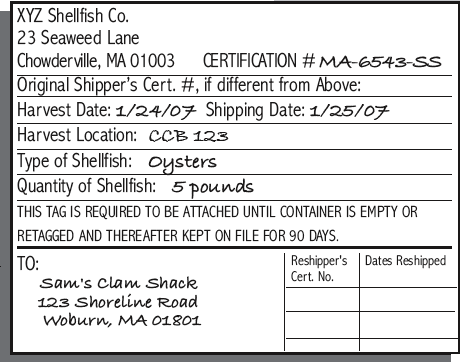
• Containers of live shellstock are properly
tagged and include the following information:
|
3-202.18 [A(1 & 2)] |
 | |
• Containers of shucked shellfish are labeled
to show the:
|
3-202.17(A) |
| AT RECEIVING Accept the product when the |
CMR 590 REFERENCE |
|---|---|
| • Temperature of shellstock is 7�C (45�F) or less. | 3-202.11 (B) |
| • Temperature of shucked shellfish is 7�C (45�F) or less. | 3-202.11 (B) |
| • Shellstock is reasonably free of mud. Discard dead shellstock and shellstock with badly broken shells. | 3.202.19 |
| FOR STORAGE AND DISPLAY To store and display shellfish |
CMR 590 REFERENCE |
|---|---|
| • Refrigerate the shellfish immediately after receipt and cool to 5�C (41�F) or less within 4 hours. | 3-501.14 (C) |
| • Hold shellfish during storage and display units at 5�C (41�F) or less. | 3-501.16 (B) |
| • Store shellfish off the floor and stack the containers to allow for good air circulation. | 3-305.11 |
| • Separate different species of raw ready-to-eat shellstock during storage and while on display. | 3-302.11 (A)(2)(b) |
| • Separate raw animal foods from cooked ready-to-eat and raw ready-to-eat shellfish during storage and while on display. | 3-302.11 (A)(1)(a&b) |
| • Do not store shellstock below foods that may drip or leak onto the shellstock containers. | 3-302.11 (A)(2)(b) |
| • If displayed on ice, it must be drained ice. | 3-303.12 (B) |
| FOR STORAGE AND DISPLAY About original containers and records |
CMR 590 REFERENCE |
|---|---|
| • Keep shellstock tags on or with the original container until empty. Once the containers are empty, remove the tags and keep them on file in chronological order for 90 days. | 3-203.12 |
| • Keep shucked shellfish in the original container until prepared for service or sold. | 3-203.11 |
| • Do not commingle (mix) shellfish from different containers or different species. | 3-203.11/12 |
| MONITORING SHELLFISH | CMR 590 REFERENCE |
|---|---|
• Periodically check to make sure that the:
|
3-501.16 (B) |
|
3-202.19 |
| • Rotate shellfish from storage to display using the FIFO (First In, First Out) system based on date of receipt. | recommended |
| SALES AND SERVICE | CMR 590 REFERENCE |
|---|---|
| • A "Consumer Advisory" is required at the point of selection in food establishments that sell or serve raw or partially cooked shellfish. | 3.603.11 |
| • Make sure that shellstock on display can be identified and that the tags are filed once the containers are emptied. | 3.203.12 |
| • Observe proper procedures to prevent contamination of the shellfish. | 3-301 through 3-307 |
| • Do not commingle (mix) shellfish from different containers or different species of shellfish. | 3-203.11/12 |
These practices are consistent with Massachusetts regulations 105CMR 590.000 which adopts by reference the federal 1999 Food Code. 3/1/07. This fact sheet was developed by the MA Partnership for Food Safety Education with support from the Massachusetts Environmental Health Association and Massachusetts Health Officers Association in cooperation with the University of Massachusetts Extension Nutrition Education Program. UMass Extension is an equal opportunity provider and employer, United States Department of Agriculture cooperating. Contact your local Extension office for information on disability accommodations or the UMass Extension Director if you have complaints related to discrimination, 413-545-4800.
*Special Requirement for Molluscan Shellfish Tanks (For Person-In-Charge) A life-support system display tank may be used for storage and/or display of shellstock intended for sale to the consumer if it is a spray-type system, not an immersion-type system, and it is operated and maintained in accordance with a variance and HACCP plan that is approved by the Department of Public Health and the local Board of Health. The immersion-type system is considered to be wet storage which is not allowed at the retail level in Massachusetts and if done at the wholesale level requires a wet storage permit approved by the Department of Public Health. [MA Food Code 4-204.110; and the National Shellfish Sanitation Program's (NSSP) Model Ordinance].