Print Versions:
The Massachusetts Partnership for Food Safety Education
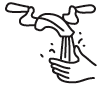
WASH HANDS
Learner/worker Objectives:
- To understand that humans are a source of harmful microorganisms.
- To understand that foods can become contaminated with harmful microorganisms from our hands.
- To improve hand washing skills.
Introduction
Microorganisms (germs) are living things like bacteria, viruses and parasites.
1They are very small (micro).
Your body is made up of one trillion small cells.
Some microorganisms like viruses are so small that
one trillion particles can fit in a 1/4 teaspoon!
2They are everywhere.
- In food - from animals or vegetables
- In the environment - in water and soil
- In and on people -
Many bacteria live and grow in your hair, nose, throat and on your hands.
Some bacteria live in your intestine. They can be spread by urine or feces.
3They can make you sick.
- Even in small numbers, some types of microorganisms can make people sick
- Some make toxins or poisons that can make people sick
- Some viruses, parasites and bacteria can cause serious illness or death
The Food Connection
Germs can spread from people to food.
1How germs get on your hands.
 Ask how germs can get on your hands
Some bacteria live naturally on your skin.
Bacteria, viruses and parasites can get on your
hands when you:
- cough or sneeze
- use the bathroom
- touch a part of your body (hair, nose, arms)
- touch your mouth
- touch raw food
- touch pets
- touch your clothes
- touch soiled dishes or tableware
- change diapers
- when you have a cut or sore
2How contamination occurs.
Germs can spread from your hands to food when your hands touch the food:
- if you don't wash your hands
- if you don't cover your hands when you have a cut or sore
Keep Food Safe
Keep germs away from food.
1Wash your hands.
Distribute and Review "Wash Hands."
To wash your hands follow these 4 steps.
- Wet your hands with warm, running water.
- Add soap and rub your hands to make a lather. Wash fronts and backs of hands, between fingers and under nails for 20 seconds. *20 seconds is time it takes to sing any nursery song twice, (the Alphabet song, Row Your Boat, Happy Birthday).
- Rinse your hands well under warm running water. Let water run into sink, not down your elbows.
- Dry your hands thoroughly with a clean paper towel or air dryer.
Demonstrate and practice proper
handwashing
Wash your hands before you touch food and AFTER YOU:
- use the bathroom
- touch uncooked meat, poultry, fish or eggs
- interrupt food preparation
- eat, smoke or chew gum
- touch soiled dishware
- touch your body
- sneeze or cough
BEFORE YOU put on clean gloves
2Do not touch food with your bare hands, if you make ready-to-eat foods.
- Wash your hands
- Use disposable gloves* or other barrier
- tongs
- deli tissue
- serving utensils
- Remove jewelry, nail polish and false nails
3Wear disposable gloves if you have a cut or sore on your hands:
- Wash your hands and cover the cut with a clean bandage
- Change gloves as often as you would wash your hands and when they become soiled or torn
Resources and Fact Sheets
Use the following resources and fact sheets for more information:
- 1999 FDA Food Code 2-301.11; 2-301.12; 2-301.14, 2-301.15
- *Guideline on Latex Glove Use in Retail Food Establishments
- Alternative Procedure for Bare Hand Contact with Ready-to-Eat Foods
- Food Employee Reporting Agreement From the Massachusetts Department of Public Health
- Food Safety WORD LIST
from UMass Extension Nutrition Education Program - Massachusetts Department of Public Health website http://www.state.ma.us/dph/fpp/retail
- UMass Extension Nutrition Education Program website: http://www.umass.edu/umext/nutrition/programs/food_safety
- Massachusetts Partnership for Food Safety Education MAFoodSafetyEducation.info